- Labour market weakens anew
- But unemployment rate now likely peaked
- No change to OCR forecasts, but higher odds of pauses
- Retail rates likely slower to rise
- Mortgage positioning returns to average
The past fortnight has been a bumpy ride for forecasters. The two big surprises we’ve had from the ecosphere both lean in the direction of interest rates being slower to rise than previously thought, but not to the extent we’ve changed our forecasts.
Labour market fails to improve
First, official labour market figures for the third quarter failed to improve in the way we’d all hoped. There were few redeeming features. Employment fell. People exited the labour force. Unemployment rose. Hours worked declined.
There wasn’t the sense – as there has been in other indicators like filled jobs and job advertisements – that the weak labour market was finally turning for the better.
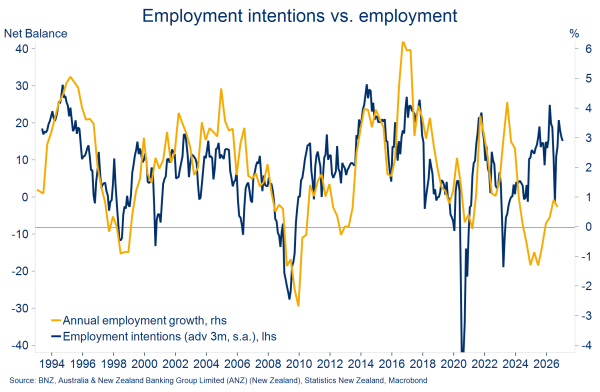
Firms have been signalling a strong intent to hire for some time now – per the chart below – but have yet to follow through to the extent history would imply. Annual jobs growth is positive but hasn’t been enough to soak up even sub-par population growth. Hence the rise in the unemployment rate; Q3’s 5.7% maintained an 11-year high.
Actual employment lagging intentions
A few other points of interest from the data:
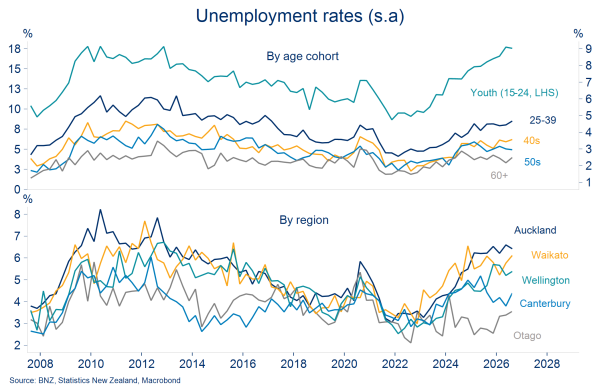
- Labour market weakness still clearly skews young and north, but elevated youth and Auckland/Northland unemployment rates didn’t increase further in Q3 (all seasonally adjusted).
Labour market weakness skews young, north
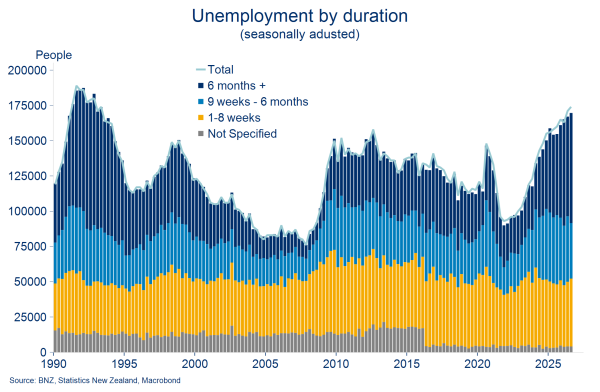
- Those unemployed for six months or longer now make up 45% of the total, holding around the highest share since 1994.
More unemployed for longer
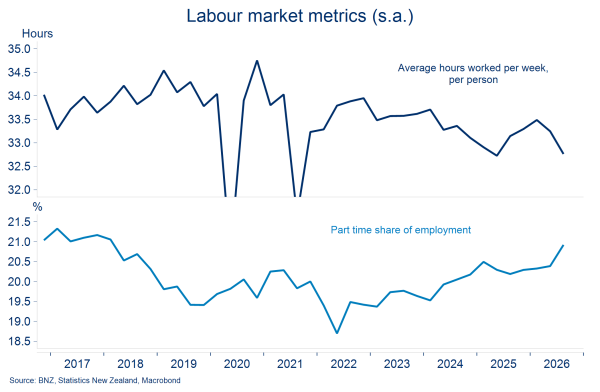
- The part-time share of employment rose to an eight-year high of 21%, helping explain why fewer hours were worked on average in the quarter.
More part-time work
- Wage data were relatively weak as expected, but not as weak as the activity data might have suggested. Only 44% of employees received a pay rise in the past 12 months. Of those that did, the majority were in the 2-3% range, with “cost of living” being the most common reason (54% of annual increases).
Looking ahead, we think unemployment has likely peaked. The labour market always lags, and broader economic momentum should increasingly translate into additional hiring, bringing down the unemployment rate next year. Our forecasts have it reaching 5.1% by the end of 2027.
On interest rates, exchange rates
The softer labour market data does query how fast interest rates might rise from here. Particularly alongside the second big surprise of the past fortnight: the Reserve Bank’s decision – by the barest of margins – to hold off lifting the OCR last Wednesday.
For now, we’ve stuck with our view that the OCR will be lifted 25bps to 3.00% next month and peak at 3.75% in the autumn. But we acknowledge the events of the past fortnight increase the odds of more RBNZ pauses along the way.
The inflation outlook is still problematic. The big decline in energy prices of recent days is certainly helpful if sustained, but the NZ dollar's renewed slide is working in the other direction via extra pressure on tradeables inflation.
Our exchange rate projections – which, given the difficulty rating, are best read as a guide to the trend – bake in only a weak recovery from here. A sustained shift above 0.6000 for NZD/USD is seen as higher odds for 2028 than for next year.
NZ dollar slow to rise
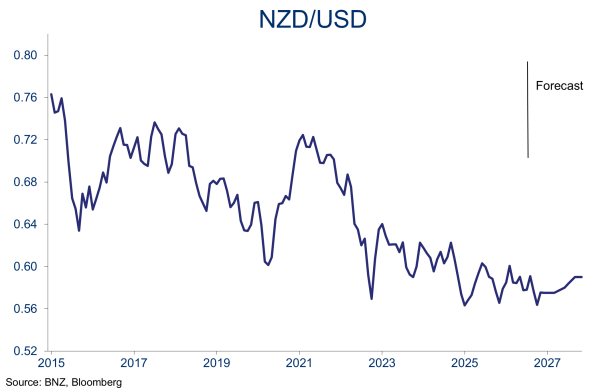
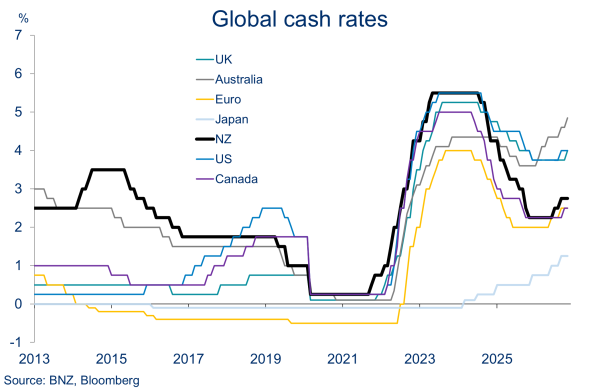
Low NZ interest rates are part of the story, but perhaps more so heightened policy rates offshore. Rate rises from global central banks are sustaining low or negative interest rate differentials between NZ and the rest of the world.
The latest to move include the Bank of Canada, which lifted its policy rate 25bps last week, the Reserve Bank of Australia which did the same on Tuesday, and the Bank of England moving its policy rate up to 4.00% this morning.
NZ cash rate lagging UK, Australia, US
With these actions adding weight, the weak NZ dollar should continue to assist the outperforming export sector. It’s of course less helpful for consumers given the implications for the cost of imports (most obviously fuel). From this perspective, the low exchange rate is probably a factor holding back some convergence in NZ’s ‘two-speed’ economy.
The various moving parts have tended to roughly balance out such that our inflation forecasts haven’t changed. They continue to feature a forecast peak of 4.5%y/y in the current quarter, and a wait until the final quarter of next year for a return to the 1-3% target range.
Uptrend in retail rates on pause?
Financial markets have been quick to pare expectations of how high and how fast the Official Cash Rate might rise from here. The implied odds of a December 25bps OCR hike are now around 50/50 with expectations of the peak shaved to 3.5% from above 4.0% a week ago. That’s knocked the top off wholesale interest rates (swap rates), returning them to the levels of August and early September.
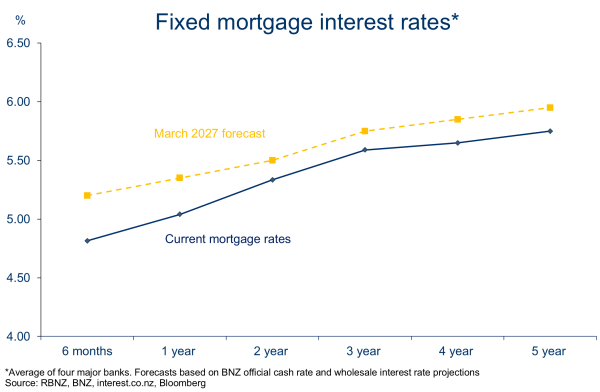
Retail interest rates may thus be slower to rise from here, and we could see the odd tweak lower if the decline in wholesale yields was to extend in coming weeks. However, we don’t see this as a break in the trend. Our fixed mortgage rate projections have been tabbed down but are still 20-40bps above current levels by March (chart below).
Upward shift slows but continues
We don’t think there are major implications from any of this for mortgage fixing behaviour or housing market activity.
Small monthly house price declines resumed in June (average of -0.3% a month to September, per s.a. REINZ HPI), and we expect more of the same through to at least year end.
Higher mortgage rates and election uncertainty appear to have been the main drags recently. We’d note that, even if we see a few downward tweaks to mortgage rates in the next few weeks, test rates seem less likely to change. Political uncertainty, meanwhile, has the potential to extend well beyond Saturday’s election.
Mortgage positioning returns to average
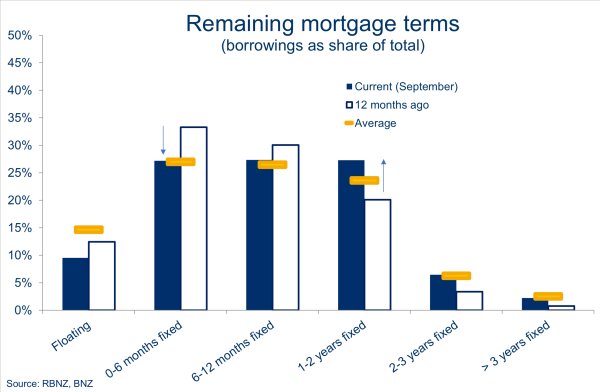
Over the past year, mortgage borrowers have made steady progress in terming out the average duration of their debt in preparation for higher interest rates. Aggregate mortgage positioning has consequently returned to about average.
The share of mortgage borrowings repricing over the subsequent 12 months (including floating debt) peaked last year at 83% – the ‘shortest’ the mortgage book had been in 13 years.
At the start of this year, that figure had eased to 72%, and it’s now 64% - pretty much bang on the long-run average. This lengthening in average term mostly reflects the 2-year fixed term's return to popularity.
As the chart shows, the share of borrowings with a remaining term of 1-2 years has lifted from below average a year ago to an above average 27%. By contrast, the share of borrowings on floating terms is now the lowest on record at 9.5%.
2-year fixed term returns to popularity
In short, mortgage borrowers are better protected against rising rates than they were. But, given where we are in the cycle, we suspect the trend towards longer mortgage terms has a little way to go yet.
To subscribe to Mike’s updates click here.
- Economy & Markets