
Choose the right fund
Use this guide to discover which of the BNZ KiwiSaver Scheme funds might suit your needs right now.
Find out which of the BNZ KiwiSaver Scheme investment funds^ might suit you best.
{"type":"half","heading":"Compare BNZ KiwiSaver Scheme Funds","bodyText":"<p>Find out which of the BNZ KiwiSaver Scheme investment funds<term reference=\"KS: Standard\"><\/term> might suit you best.<\/p>","actionLinkHref":"\/personal-banking\/kiwisaver\/transfer-or-join?link=headercta","actionLinkLabel":"Join or transfer","supportingLinkHref":null,"supportingLinkLabel":null,"theme":"boxed","heroImage":{"height":460,"position":{"x":"45%","y":"40%"},"title":"Compare funds Page header half fam bbq","url":"\/assets\/bnz\/personal-banking\/kiwisaver\/images\/Compare-funds-Page-header-half-fam-bbq.jpg?67d482d2923ce08770f22075ad18af3e4c3e1230","width":465},"heroImage2x":{"height":920,"position":{"x":"48%","y":"38%"},"title":"Compare funds Page header half fam bbq 2x","url":"\/assets\/bnz\/personal-banking\/kiwisaver\/images\/Compare-funds-Page-header-half-fam-bbq_2x.jpg?1709fe660a67de122660cb75838337a527ace6e2","width":930},"smallHeroImage":{"height":300,"position":{"x":"43%","y":"42%"},"title":"Compare funds Page header mobile fam bbq","url":"\/assets\/bnz\/personal-banking\/kiwisaver\/images\/Compare-funds-Page-header-mobile-fam-bbq.jpg?850f60c50336f82fa2022c0443ab501ce9535338","width":563},"smallHeroImage2x":{"height":600,"position":{"x":"37%","y":"43%"},"title":"Compare funds Page header mobile fam bbq 2x","url":"\/assets\/bnz\/personal-banking\/kiwisaver\/images\/Compare-funds-Page-header-mobile-fam-bbq_2x.jpg?d262f5fe78f014823695f60313ddc8485e2c1172","width":1125}}
The BNZ KiwiSaver Scheme has a range of funds to invest in, each offering a different level of potential return depending on the types of assets the funds are invested in, and the amount of risk you’re willing to take.
Growth assets^ will typically experience larger movements in value compared to income assets^, so they have the potential to achieve higher investment returns over the longer term, however you need to be willing to accept more risk.

Aims to achieve the highest returns of the Funds over the long term.
Target investment mix
100% growth assets^
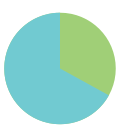
| 67% |

|
International equities |
| 33% |

|
Australasian equities |

Aims to achieve higher returns over the long term.
Target investment mix
20% income, 80% growth assets
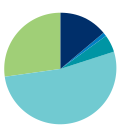
| 53% |
|
International equities |
| 27% |
|
Australasian equities |
| 14% |

|
International fixed interest |
| 5% |

|
New Zealand fixed interest |
| 1% |

|
Cash & cash equivalents |

Aims to achieve a medium level of return over the medium to long term.
Target investment mix
40% income, 60% growth assets
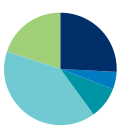
| 40% |
|
International equities |
| 26% |
|
International fixed interest |
| 20% |
|
Australasian equities |
| 9% |
|
New Zealand fixed interest |
| 5% |
|
Cash & cash equivalents |
Aims to achieve a medium level of return over the medium to long term.
Target investment mix
40% income, 60% growth assets
| 40% |
|
International equities |
| 26% |
|
International fixed interest |
| 20% |
|
Australasian equities |
| 9% |
|
New Zealand fixed interest |
| 5% |
|
Cash & cash equivalents |

Aims to achieve moderate returns over the medium term.
Target investment mix
60% income, 40% growth assets
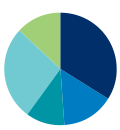
| 34% |
|
International fixed interest |
| 27% |
|
International equities |
| 15% |
|
Cash & cash equivalents |
| 13% |
|
Australasian equities |
| 11% |
|
New Zealand fixed interest |

Aims to achieve relatively stable returns over the short to medium term.
Target investment mix
80% income, 20% growth assets
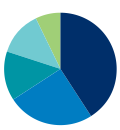
| 41% |
|
International fixed interest |
| 25% |
|
Cash & cash equivalents |
| 14% |
|
New Zealand fixed interest |
| 13% |
|
International equities |
| 7% |
|
Australasian equities |

Aims to achieve relatively stable returns over the short to medium term.
Target investment mix
85% income, 15% growth assets
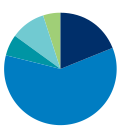
| 60% |
|
Cash & cash equivalents |
| 19% |
|
International fixed interest |
| 10% |
|
International equities |
| 6% |
|
New Zealand fixed interest |
| 5% |
|
Australasian equities |
BNZ KiwiSaver Scheme Fund performance to 31 August 2026.^
Returns are calculated after deducting Management Fees but before deducting tax.
Past performance is no guarantee or indication of future performance.
Use this guide to discover which of the BNZ KiwiSaver Scheme funds might suit your needs right now.
See how changing your fund or contribution rate could have a big impact on potential savings for the future.
Before making any investment decision, read the Product Disclosure Statement (PDF 962KB) to find out key information about the BNZ KiwiSaver Scheme.
When you invest in a BNZ KiwiSaver Scheme fund, you’re issued with ‘units’ in that fund. Each unit has a unit price. Whenever you make a change which requires you to buy or sell units in the fund, a buy or sell spread is applied to the unit price. Any contribution into a fund will use the ‘buy price’, and any withdrawal from a fund will use the ‘sell price’.
Unit prices may go up or down between the time it takes to submit your contribution, transfer, withdrawal, or fund switch request, and the time it’s received and approved, and the date the relevant units are actually issued or redeemed.
The latest available buy and sell unit prices are shown below. You can view previous prices using the date selector.
If you need some help call 0800 269 5494.