- RBNZ tightening begins as expected
- Markets have priced in lots more, meaning mortgage rate upside concentrated more on shorter terms
- Flat forecast for 2026 house price inflation retained
- Wide range of possibilities for 2027; we trim our expectations
The view, in brief
Since our last update, NZ house prices have continued to shuffle sideways, and the Reserve Bank has started to lift the OCR. Neither is a surprise, so we haven’t messed with our short-term interest rate and house price forecasts. We still judge a higher chance of house price inflation undershooting our flat 2026 forecast than overshooting.
Further increases in particularly shorter-term mortgage rates are implied by our interest rate view, but gains will be tempered by the 130bps of OCR hikes already built into market pricing. The break-even hurdle for longer-term fixes consequently looks higher, meaning the fixing decision looks more evenly balanced than it was.
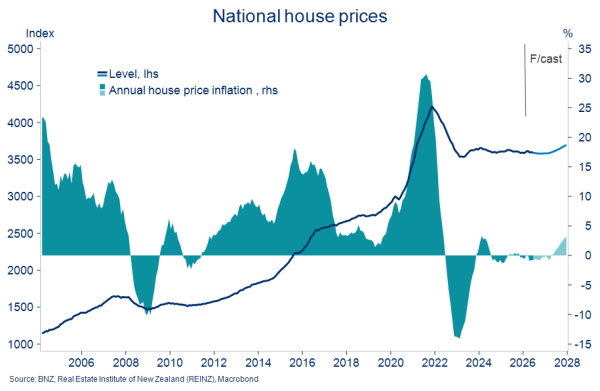
With the half-way point for 2026 in the rear-view, we’ve had a closer look at house price forecasts for 2027. The range of possibilities is naturally wide! We’ve assumed a 3% house price gain, a tad lower than previously. We caution against focusing on the point forecast – it’s essentially a view of low but positive nominal house price inflation, implying a negligible real increase.
Welcome to our third quarter Property Pulse. Supporting our more regular EcoPulse updates, we run through recent housing and mortgage rate happenings, and provide our take on the outlook.
Included in report:
- The view, in brief
- House price outlook
- Mortgage rate outlook
- Appendix: Regional Heatmap
House price forecasts
Impact of macro drivers on our house price view
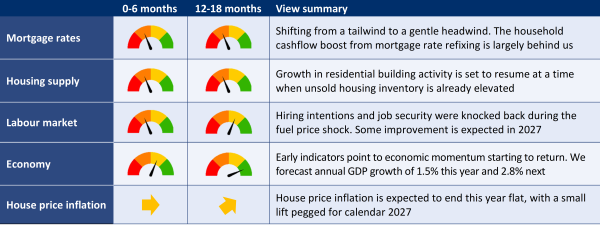
The table below summarises the various drivers of house price inflation and their directional impact on our view.
What’s the half time score?
Last week’s release of June REINZ data allow us to tally the performance of the housing market over the first half.
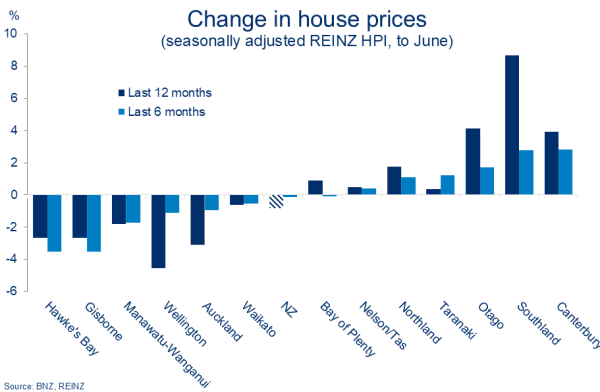
National house prices were essentially unmoved over the past six months (all data seasonally adjusted). Technically, June’s read on the REINZ House Price Index (HPI) was 0.1% lower than December 2025.
Signs of life through the first quarter were later unwound with the HPI falling 0.7% from March to June. The details reveal the clear and now-familiar North vs. South dynamic.
Unchanged at the half-way point
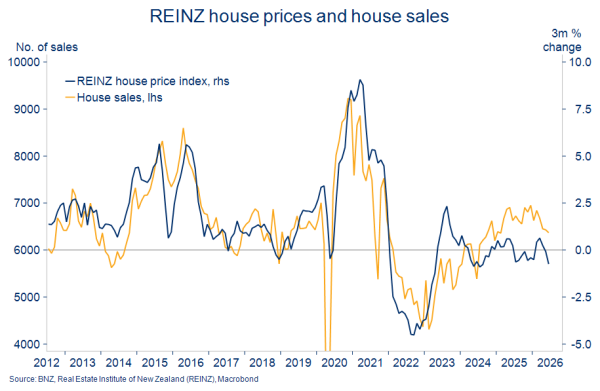
Housing market activity chugged away but softened as the first half wore on. Having recovered to about average at the turn of the year, the pace of house sales progressively throttled back such that June’s read was about 5% below average.
This renewed caution likely reflects a range of factors including the hostilities in the Middle East, the associated (and hopefully brief) stalling in the domestic economy, a still weak labour market, election and capital gains tax uncertainty and, probably most importantly, rising mortgage rates.
Pace of house sales eased in first half
What’s the view from here?
We haven’t changed our broad expectation that NZ house prices will end 2026 close to where they started.
Our flat house price inflation forecast for 2026 assumed a steadying in prices towards the end of the year following a mid-year sag.
The mid-year sag bit is playing out. And the apparent rebuilding of NZ economic momentum we’ve seen in recent data plays to the grain of some steadying in the housing market later in the year. Nonetheless, we’d still assess a higher chance of house prices undershooting our 2026 expectations than an overshoot.
What about 2027?
Looking ahead to next year, the range of possibilities is naturally wide. Forecasting house prices at that sort of horizon is tricky to say the least.
We’ve assumed a 3% gain over calendar 2027. We caution against focusing on the point forecast – it’s essentially a view of low but positive nominal house price inflation, implying a negligible real increase.
There are many push and pull factors influencing the outlook – the so-called ‘known unknowns’. There will also be the, probably more impactful, ‘unknown unknowns’ – the surprises and shocks that turn up along the way. But based on what we know now, our view is built upon the below three dynamics:
1. Firming housing demand, but with a reshuffling of the drivers. Interest rates are shifting from a tailwind to a gentle headwind. The Reserve Bank kicked off a tightening cycle earlier this month as expected, underscoring the rise in mortgage rates, and solidifying our expectation the cashflow boost from mortgage refixing is largely behind us.
You could be forgiven for thinking the interest rate easing cycle came and went with little discernible impact on housing demand. We think lower interest rates did in fact loosen things up, but their demand-side impact was offset by a weak economy, low population growth, and a soft labour market.
Cycles about to turn?
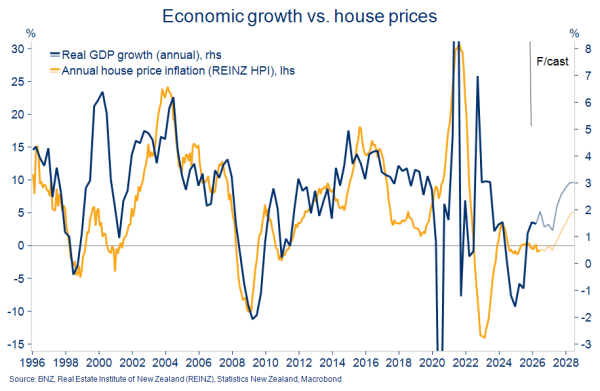
Our view from here is essentially a flip-around of those demand drivers. A mild drag from rising mortgage rates is expected to be offset by an improving economy, lifting but still low population growth and, eventually, a firming in labour market conditions.
2. A still-strong supply pipeline. Additional housing demand need not translate into higher house prices if it is met by additional supply.
Listings remain plentiful and unsold inventory continues to grind higher. As of June, there was 5½ months’ worth of inventory on the market, the highest in two years. The number of outstanding listings is the highest in 11 years.
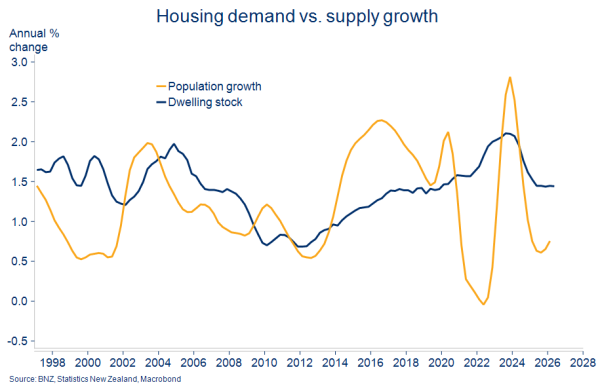
Population and house building dynamics are difficult to track in real time let alone forecast. Our overriding view is that a still-chugging supply response will maintain the housing market in a broad state of balance. We’re forecasting upswings in both population growth (demand) and residential construction (supply) over the next 12 months, the latter supported by the recent burst of consenting activity. It’s unclear which side will dominate, but our forecasts have the growth rate of the supply side holding above that of population growth.
Supply > demand?
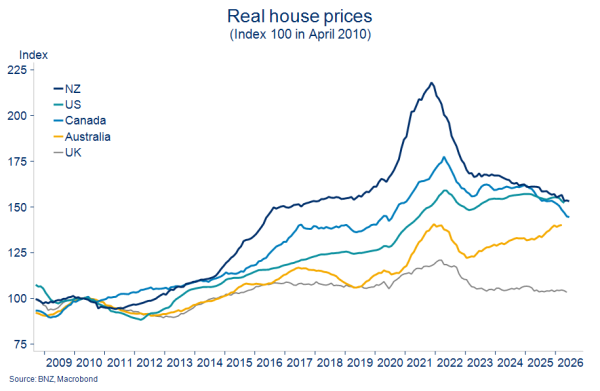
3. A starting position for house prices that doesn’t appear low. We recently compared a smattering of house price valuation metrics across peer countries. There are always riders and caveats with this sort of stuff. But the general conclusion was that, despite some retrenchment in recent years, NZ house prices still line-up as middling-to-elevated when viewed over a longer period.
Real house price changes since 2010
The net of (1) to (3) leaves us with a view of housing demand gradually lifting over the next 12-18 months but with much of it being met by supply. Consequently, only a modest increase in house prices results. As always there are risks in all directions, but we think they’re roughly balanced around this view.
Mortgage rate outlook
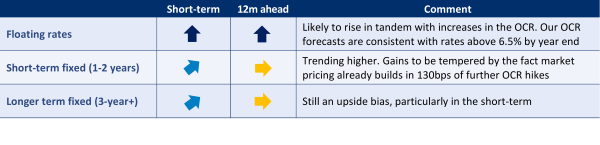
Our view at a glance (all based on our forecasts for the Official Cash Rate and wholesale interest rates)
Floating rates – so it begins
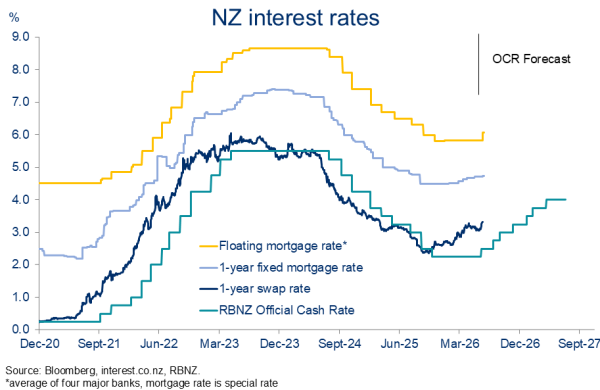
The Reserve Bank (RBNZ) raised the cash rate earlier this month as we’d expected. The 25bps lift to 2.50% was the first in three years. It’s likely to be the first of many but, as always, the strength of the economy and inflationary pressure will ultimately carry the day.
We reckon the RBNZ’s messaging is consistent with at least two further 25bps hikes in the available three meetings of this year. It gets trickier thereafter, particularly given fresh hostilities in the Middle East.
Nonetheless, we still think the cash rate will end up well north of “neutral” (thought to be around 3.00-3.50%, depending on the relevant time horizon), particularly if economic growth bounces as we expect. Our forecast peak in the cash rate remains 4.00% by May, although the risk profile skews marginally south of this.
Based on this outlook, further increases in floating mortgage rates are very likely. They’re currently just over 6.00% following a round of post-RBNZ tweaks. They’re likely to end the year above 6.5%, with a push through 7.0% in the first half of 2027 on the cards based on our view of steady OCR adjustments from here.
Floating rates to rise with OCR
Fixed rates – uptrend to run a little further
Fixed mortgage rates so far haven’t budged in response to the Reserve Bank’s OCR adjustment. That’s of no surprise given the move was expected and pre-built into market pricing.
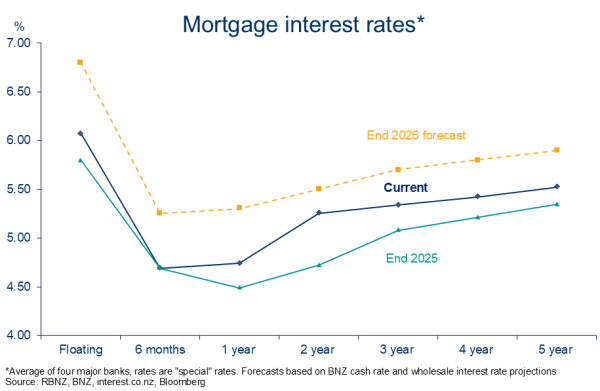
So far this year, fixed rates have lifted between 20bps (5-year) to 50bps (2-year) as a tightening cycle has been progressively factored into market expectations. This will naturally limit how much further fixed rates rise as that cycle is delivered upon.
We nonetheless retain an upward bias for term mortgage rates. Wholesale interest rates will naturally drift upwards as the cash rate is pushed higher, with our forecasts for OCR hikes a little more front-loaded than market pricing. The pop higher in wholesale interest rates since the RBNZ Statement adds a bit of short-term upward pressure on retail rates.
The chart below sets out our forecasts for the mortgage curve through to the end of the year. The eagle-eyed will note some ‘flattening’ is implied – six-month and 1-year rates rising a little more than those for longer-terms. That would be typical of the ‘steepen in anticipation, flatten on delivery’ response to past OCR tightening cycles.
Mortgage curve shifts up
Mortgage Strategy
Before diving into the rate fixing debate, it’s worth reiterating that getting a mortgage strategy “right” is primarily about meeting a borrower’s financial needs and requirements for certainty. Trying to pick the timing of interest rate movements is fraught with difficulty.
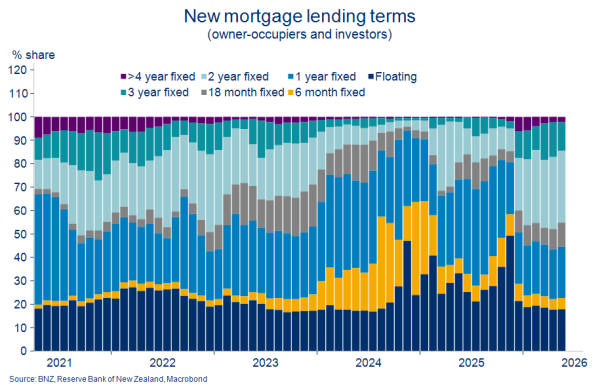
Mortgage borrowers pivoted aggressively towards longer fixed terms in December. And that renewed preference for particularly 2-year fixed terms has continued in the six months since. It was a prescient shift given that fixed rates have trended up since the turn of the year and the RBNZ has now begun lifting the OCR.
Pivot to longer terms
The question for those soon to experience a refix or drawing new mortgage debt is whether longer-term fixes are still worthwhile given higher term rates.
For example, the current two-year carded rate of 5.3% is about 60bps above the 6-month rate (4.7%) – the largest gap in four years.
To hit financial breakeven on fixing for two years thus implies a significant rise in short-term rates over the next couple of years. Increases are indeed likely as the OCR rises, but this breakeven hurdle is looking harder to achieve based on our forecasts.
All else equal, that might have some looking a little more closely at shorter term fixed rates. For example, by rolling for another six months or year and looking to term out mortgage debt for a longer term after that. That would entail paying a lower rate in the short term, but the downside is potentially rolling off into the middle of an RBNZ tightening cycle, with the associated uncertainty on what the menu of refixing options might be at that time.
It’s also worth remembering that hedging or fixing for longer terms helps control risk in an environment where shocks from offshore seem to be increasing in frequency and broader household costs are rising. Some may thus place extra value on the peace of mind of longer term fixes, meaning that the higher upfront costs are worthwhile.
Overall, we think the mortgage fixing decision is looking more evenly balanced. That follows a reasonable period in which we thought value tilted towards longer terms. That more balanced environment potentially lends itself to individual borrower preferences (rather than market factors) playing more a role in the fixing decision and/or spreading risk across a range of terms.
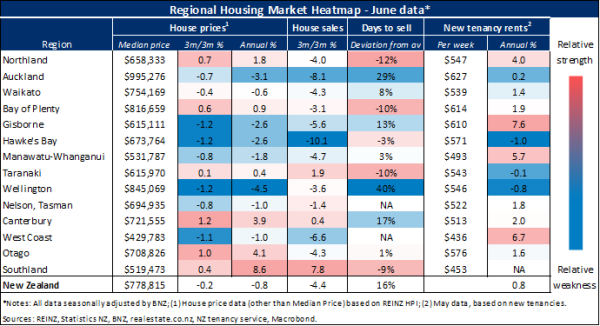
Appendix: Regional Heatmap
- Regional heat patterns across NZ’s housing market have an increasingly familiar feel about them. That is, cool climes lingering in Wellington, Auckland, and eastern parts of the North Island. Warmer conditions prevail elsewhere, particularly Canterbury and the deep South.
- Relativities in the pace of house sales, which can hold some leading information for prices, provide few signs these relative trends are about to change.
- Economy & Markets