- We sift April data for how consumer spending patterns are changing
- Impact of spiking fuel costs obvious
- Broader spending fundamentals also set to drag:
- Soggy labour market conditions to extend
- Near-term downside risk for house prices, but with one eye on a reducing supply/demand gap
- Cashflow boost from mortgage refixing ending
- No change to our interest rate views, including an unchanged RBNZ OCR decision next week
Early shifts in consumer spending patterns post the disruption in the Middle East have become clearer as the numbers have rolled in for April.
Sifting through the latest BNZ and Stats NZ retail card spending figures, as well as Monday’s Performance of Services index, shows:
- Spending on fuel declined in April, despite double-digit price increases. Volumes are falling, in other words, as those that can reduce fuel demand do so.
- After some front-loading in March, spending cutbacks were made across most spending categories in April.
Areas of discretionary spending under the most pressure appear to be hospitality, apparel, domestic travel and tourism, and recreational activities.
View as PDF
Discretionary spending cuts help pay the fuel bill
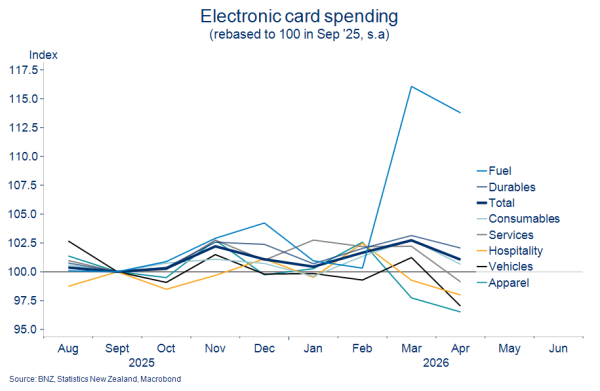
- Spending on durable goods has so far fared relatively better but this may reflect folk getting ahead of perceived price rises. Potentially falling into this bracket was the outperformance of the DIY/building supplies category in April BNZ card spend data.
- The front-loading of vehicle purchases boosting March spending figures proved fleeting.
These data reference the value of nominal spending. So the real or inflation-adjusted spending pulse will be weaker again. So, all in all, there’s nothing here to disturb our view that economic growth stalled in the second quarter. That’s after what was probably a reasonable Q1.
It’s also clear that not all of the cost shock has filtered through to consumer prices. We’ve recently revised down our second quarter inflation forecast to 4.0% (from 4.5%).
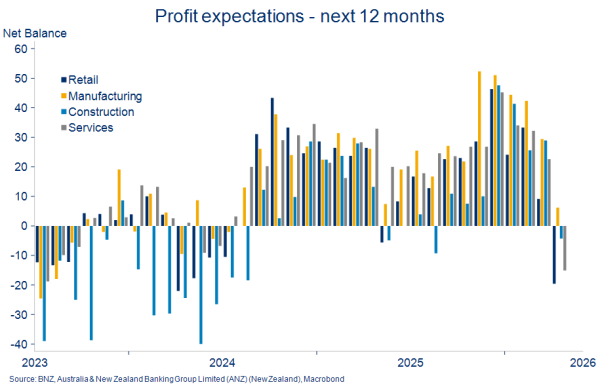
Firms are absorbing some of the hit. Business surveys are showing notably less upward movement in selling price expectations compared to costs. Profitability expectations, as proxied for example by the ANZ confidence survey, are consequently under severe strain.
Business profitability taking a hit
Retail fuel prices have backed off a little in May so far, roughly in line with movements in offshore refined fuel prices and the NZ dollar. That might soothe some of the sticker shock for households. Whether these declines are sustained is of course the bigger question and impossible to gauge.
Abstracting from fuel and other price impacts for a moment, broader fundamental headwinds for household consumption are gathering. Below we whip through what we’re seeing in the labour market, housing market, and mortgage interest rates.
As a wise man once said, ‘things are now in motion that cannot be undone’. That is, even if the flow of oil through the Strait of Hormuz was soon restored, it’s unlikely these trends would be quick to turn around.
A soggy jobs market
We went deep on the labour market in our last note. Suffice to say, the recent period of soggy labour market conditions now looks likely to extend through 2026. Elevated job insecurity, low turnover, and pressure on real wages are not conducive to a reflation of spending appetites, particularly on large and discretionary items.
Today’s job ads figures for April provided more evidence that firms’ hiring plans are being put on hold. That’s a message coming through in business surveys as well.
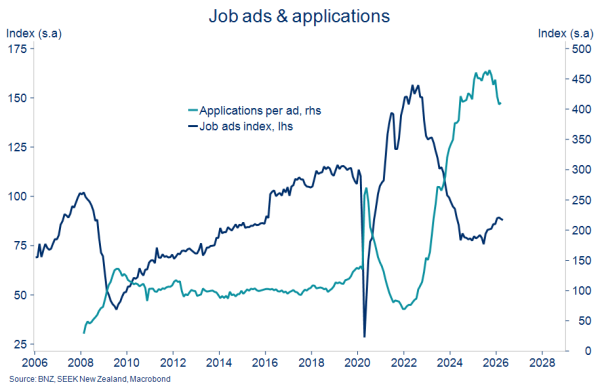
SEEK job ads fell 0.7% from March (s.a), the second monthly decline. Prior to March, ads had lifted for eight consecutive months.
The level of job ads is still consistent with employment growth but a tick up in the number of applications per ad (in March) leans in the direction of additional labour market capacity. Labour demand falling short of supply, in other words. That’s built into our forecast for the unemployment rate to drift up to 5.6% by year end.
Positive jobs market trends at risk of faltering
Housing drags, global picture less so
Historically, household spending in NZ has been closely correlated with house prices. There’s debate about whether the correlation has waned in recent years but, regardless, it doesn’t look like this wealth effect channel will be back in action anytime soon. Well not in the northern two thirds of the country anyway.
The small fall in national house prices over April has already been widely reported (-0.4% REINZ HPI, s.a.). But we think a clearer sign of the changing fortunes of the market has been the turn down in transaction activity.
The pace of (seasonally adjusted) monthly house sales peaked in December and, as of April, was running well below this. This points to the housing market losing momentum well before the uncertainty from the Iran war showed up. Higher mortgage rates from December are the likely culprit.
Our assessment of the partial data and anecdote suggests May is looking at least as weak as April. This tips to the downside the risks around our flat forecast for house price inflation through 2026. That we haven’t changed it reflects both extreme uncertainty and some of the other drivers of the market.
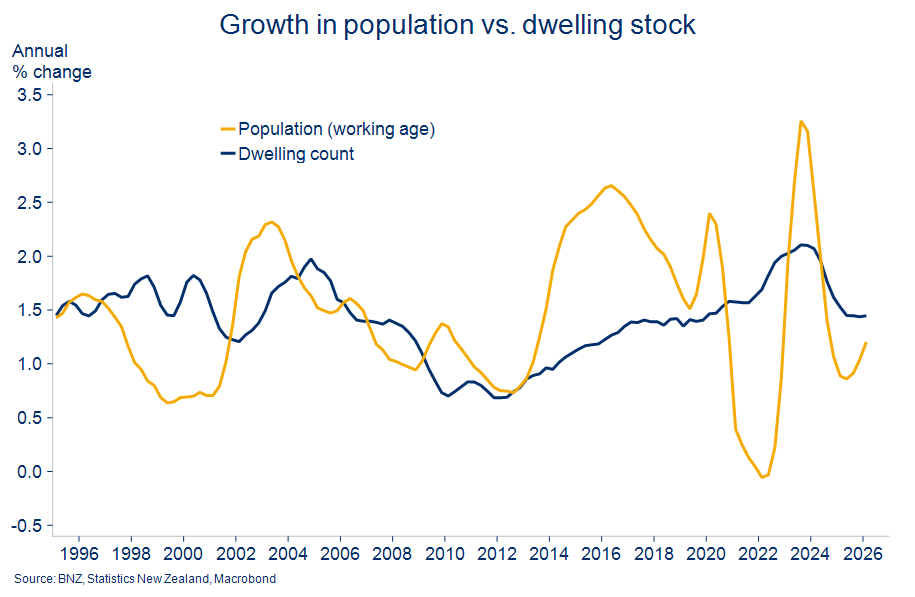
We may yet see some steadying in confidence later in the year should the war reach some sort of resolution. We’d also note the migration cycle looks to have turned upward, pushing population growth back towards average sorts of levels. In March, annual net migration rose to a 15-month high a little above 24k.
At the same time, higher construction costs risk home-building activity tailing off a little in the second half of the year once the recent burst of consents are worked through.
Auckland, Wellington well supplied, Southland, BoP less so
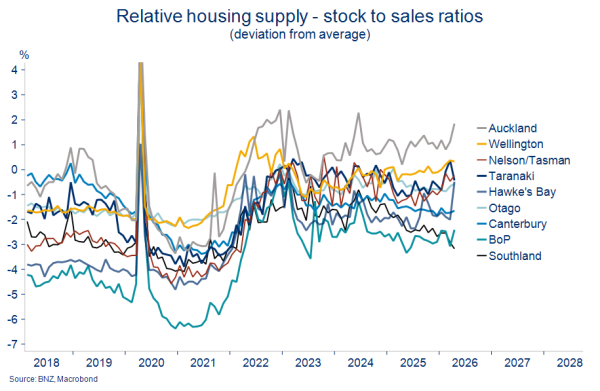
At the margin, these factors may slow the build-up of unsold inventory that has been a feature of particularly the Auckland and Wellington property markets (chart above). Already, population growth has closed some of the gap to growth in housing supply (data in chart to Q1).
Population growth closes gap to housing supply
If housing remains a drag, it’s worth acknowledging there may be at least some steadying impact on household wealth perceptions from what’s happening offshore. Global equity markets have not only reclaimed February’s all-time high but have pushed on a further 3% or so, helpful for KiwiSaver balances.
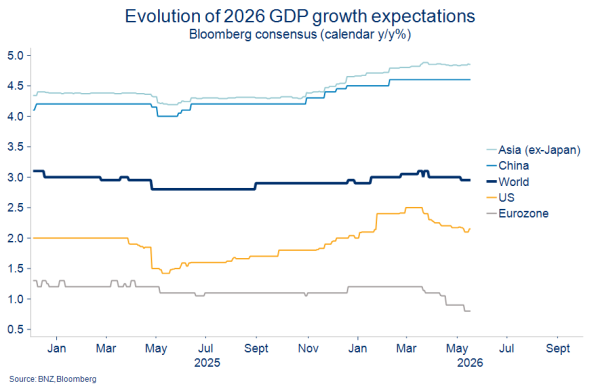
We won’t add our two cents on how sustainable all this is; suffice to say global growth forecasts have, so far, held in remarkably well through the recent period of tumult.
Global growth expectations hang in there
Cashflow boost from mortgage refixing peters out
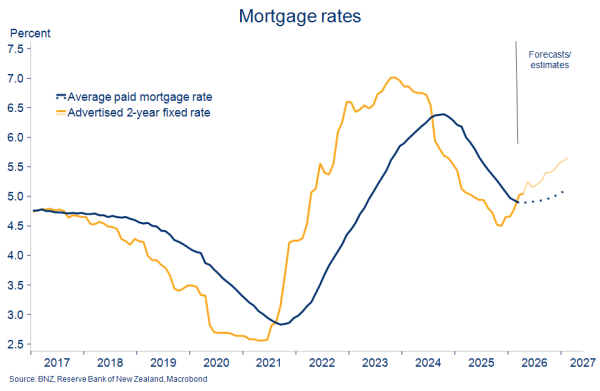
The influence of mortgage positioning on household cash flows is rounding an inflexion point. The average interest rate paid on mortgage borrowings fell 150bps over the past 18 months, providing an important boost to cashflows.
However, that period is now in its closing stages. Term mortgage interest rates started rising in late in 2025. This, rolled in with our forecasts and borrowers’ renewed preference for longer terms, implies the average mortgage yield is largely done falling and will start to rise again in the second half of 2026.
Inflexion point
The flipside is that the recent flurry of mortgage refixing activity has resulted in a lengthening of the average borrowing term. For example, the proportion of mortgage borrowings with remaining terms of 1-2 years has risen from a lowish 14% of the book 12 months ago to now be bang in line with the 24% long-run average.
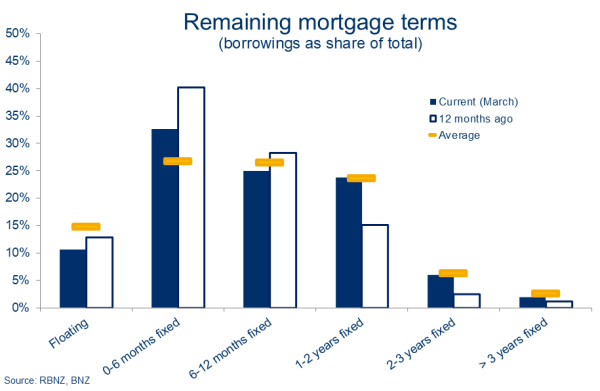
Borrowers, in aggregate, are thus initially less exposed to increases in mortgage rates from here. The effective mortgage rate will be slower to rise.
The fact market pricing already bakes in a chunky Reserve Bank tightening cycle will also limit how quickly mortgage rates rise this year. Three 25bps OCR hikes are enshrined in pricing for this year, with a July start to the tightening cycle near fully priced.
We continue to call a September start – acknowledging a still wide range of possible scenarios. All eyes at next week’s meeting will be on the Reserve Bank’s interest rate projections which, relative to February, we think will show an earlier start to hikes with a potentially higher end point.
- Economy & Markets