We sat down with Chris Wilson, Co-CEO of Harbour Asset Management (Harbour), to discuss what’s been happening in investment markets this year, and a look ahead at what investors might expect in 2025. BNZ Investment Services Limited, the manager of the BNZ KiwiSaver Scheme and YouWealth, is a wholly owned subsidiary of Harbour.
How have investment markets performed this year?
Global stock markets have shown strong performance this year, particularly in the technology sector where innovations in artificial intelligence (AI) have catalysed growth. Major tech companies like Microsoft, NVIDIA, and Amazon have reported robust earnings, reinforcing investor confidence and driving broader market momentum.
In addition to tech and AI developments, several key factors have influenced markets:
- Corporate earnings have generally exceeded expectations
- The US presidential election cycle has influenced sentiment as investors monitor potential policy implications
- Inflation has been trending downwards, improving market sentiment
- Softening inflation is reshaping interest rate expectations.
How has inflation impacted investment markets?
Inflation has been moderating globally, with the US seeing rates stabilise around 2.6%, a significant shift that has boosted market confidence. This cooling inflation trend paves the way for central banks around the world to ease their monetary policy stance.
Here in New Zealand, the Reserve Bank of New Zealand (RBNZ) has recently pivoted towards interest rate cuts, a welcome move for many households. This shift in monetary policy outlook could help local and global share markets, particularly for interest rate-sensitive sectors like property and utilities, while also supporting broader market sentiment.
How’s performance looking for the BNZ KiwiSaver Scheme and YouWealth?
Performance of the BNZ KiwiSaver Scheme and YouWealth funds has been strong this year – rewarding investors who remained patient through the more challenging markets of 2022 and 2023.
This recovery demonstrates the benefits of maintaining a long-term investment approach during periods of market turbulence. While most investors will have seen positive returns overall this year, it’s important to note that markets have experienced their share of ups and downs along the way.
BNZ KiwiSaver Scheme – One year performance to 31 October 2024
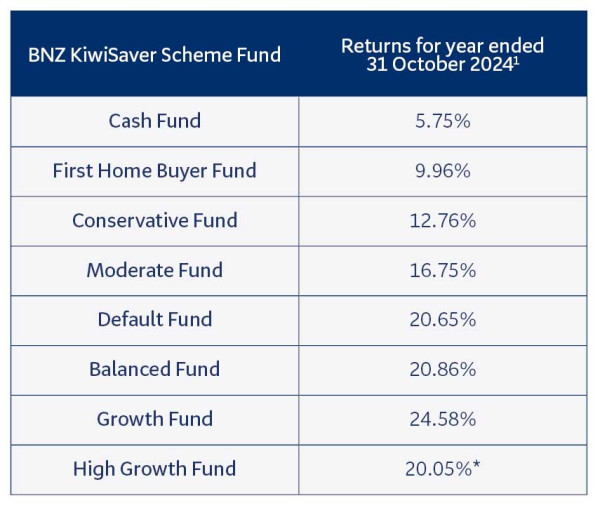
*The High Growth Fund return shown is since inception on 28 November 2023.
To view fund performance for YouWealth visit the YouWealth managed funds hub
What about responsible investing – how is this evolving?
Environmental, social, and governance (ESG) factors are now firmly in the mainstream and are no longer on the sidelines of investment decisions. This shift reflects a fundamental change in how companies are valued and assessed. We’re seeing this particularly with climate-related risks and opportunities, where companies are being evaluated not just on their financial performance, but on how well they’re preparing for the transition to a lower-carbon economy.
Human rights and nature are increasingly key focus areas for responsible investing.
- As a serious human rights violation, modern slavery presents a material risk in global supply chains. Investment managers have a crucial role in driving corporate transparency and accountability in addressing these issues.
- Companies operating in areas affected by armed conflict face heightened human rights risks. Investors are increasingly scrutinising these companies, focusing on potential violations and the need for rigorous risk assessment.
- Protecting nature and biodiversity requires significant investment, estimated at US$1 trillion per annum, with current investment sitting around US$1 billion per annum.
What might influence markets in 2025?
With inflation showing signs of moderating in many major economies, we’re seeing a recalibration when it comes to interest rates, and this has an impact on financial markets. For example, fixed interest assets could continue to see improved valuations, and property-related investments may also benefit. While markets have shown resilience, there are ongoing risks to be aware of including market volatility, geopolitical tensions, and broader economic uncertainties.
With this year’s market returns exceeding long-term averages, we could see more moderate returns next year – however, time will tell. Volatility in markets is likely to continue as several key themes play out. The ongoing weakness in China’s economy, developments in artificial intelligence, and political uncertainties – including Donald Trump’s recent election victory – could all impact market movements in 2025.
In this environment, diversification remains crucial. Spreading investments across different sectors, regions and asset types helps protect portfolios from concentrated risks and helps to capture opportunities across markets. While markets have performed well overall, periods of uncertainty and price fluctuations are normal and should be expected. The key is understanding that volatility is a natural part of investing.
- Wealth & Personal Finance