Investment markets had an eventful year to 31 March 2026, shaped by big changes in investor confidence around global trade rules, the rapid rise of artificial intelligence (AI), and gradually improving conditions in New Zealand. While there were significant periods of volatility (ups and downs) during the year, all funds in the BNZ KiwiSaver Scheme delivered strong returns over the 12-month period.
BNZ KiwiSaver Scheme one year performance to 31 March 2026 below:
BNZ KiwiSaver Scheme Fund |
Returns for year ended 31 March 2026^ |
| Cash Fund | 3.20% |
| First Home Buyer Fund | 4.24% |
| Conservative Fund | 4.50% |
| Moderate Fund | 6.71% |
| Default Fund | 9.42% |
| Balanced Fund | 8.76% |
| Growth Fund | 10.66% |
| High Growth Fund | 12.55% |
Returns are calculated after deducting Management Fees but before deducting tax.
Trade tensions kept markets on edge
The year began with a sudden shock. On 2 April 2025, markets reacted sharply to President Trump’s “Liberation Day” tariff announcement before recovering quickly after the administration announced a 90-day pause and reached a trade framework agreement with China and other key trading partners. Trade tensions stayed in the background throughout the year. In early 2026, the US Supreme Court ruled the tariffs were illegal, but the administration moved quickly to impose a broad 10% tariff on all imports under separate legislation.
Artificial intelligence remained influential, but narrative shifted
Artificial intelligence remained the biggest story for markets during the year. Major “Hyperscaler” (large tech) companies committed to spending hundreds of billions of dollars on AI infrastructure, including data centres and advanced computer chips. This drove strong gains in technology shares, particularly in the US, where companies like Nvidia and Alphabet reached record prices. Nvidia became the first company in history to reach a market value of US$5 trillion. However, enthusiasm was not without its limits. In early 2026, some of this optimism gave way to AI anxiety, with a sharp share price decline in software companies seen as most at risk to the rapidly advancing technology.
New Zealand showed signs of recovery
In New Zealand, the year was marked by a slow improvement in economic conditions. The Reserve Bank of New Zealand continued to cut interest rates over the year, reducing the Official Cash Rate from 3.75% to 2.25%. Lower borrowing costs helped reduce pressure on household budgets and helped the local housing and share markets. The agriculture sector was a positive highlight, with Fonterra's strong milk price providing a noticeable boost to rural communities, and a large payout to shareholders from the sale of its consumer business adding further support.
A challenging end to the year
Tensions in the Middle East became the main focus in late February and March, as the conflict damaged energy infrastructure across the region and effectively closed the Strait of Hormuz, a key shipping route. Oil and gas prices rose sharply in response, pushing share and bond prices down as investors assessed the impact of higher inflation and slower growth around the world.
Looking ahead
Looking ahead, uncertainty remains. The path of Middle East tensions, the direction of US trade policy, and the long-term impact of AI on businesses and economies could have a big impact on markets. In New Zealand, lower interest rates are providing some support, though the recovery remains fragile. A drawn-out Middle East conflict adds to the risk of softer growth and persistent inflation in the period ahead.
Staying the course
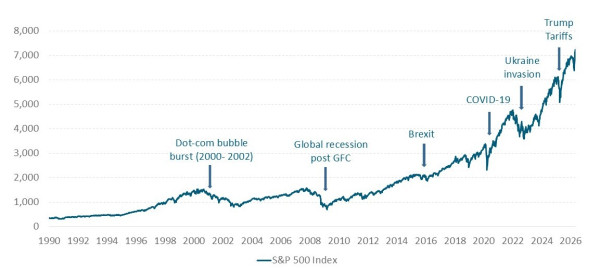
Source: Bloomberg, Harbour Asset Management
The chart above shows how markets have recovered from major setbacks over many decades. From the Global Financial Crisis to the COVID-19 pandemic, history shows that while markets can fall sharply, they usually recover and go on to reach new highs over time. For BNZ KiwiSaver Scheme investors, that reinforces the importance of focusing on your long-term goals and choosing a fund that matches your timeframe and risk profile. Periods of volatility are a normal part of investing. Learning to ride out the bumps could have a positive impact on your investment account balance over the long term.
^The returns are calculated on the change in the unit price of each fund over the period specified, adjusted for tax credits. Each BNZ KiwiSaver Scheme member's return will vary based on the unit price applicable to each contribution or withdrawal that is made and how long they have been invested for. Returns represent historical performance only and are not an indication or guarantee of future performance. The value of a fund may rise or fall depending on market conditions. Returns are calculated after deducting management fees and before deducting tax in accordance with the Income Tax Act 2007.
- Wealth & Personal Finance
- Economy & Markets