What’s an offset home loan?
Using an offset home loan could help save you money and pay off your loan faster. In this article we’ll look at what an offset home loan is, how it works, and why it could be worth considering.
0 minute read

Exploring your home loan options can be a bit overwhelming, whether you’re looking to buy your first home or have had a home loan for years.
This is because they come in a variety of shapes and sizes, all suited for different needs. One type is an offset home loan.
What is an offset home loan?
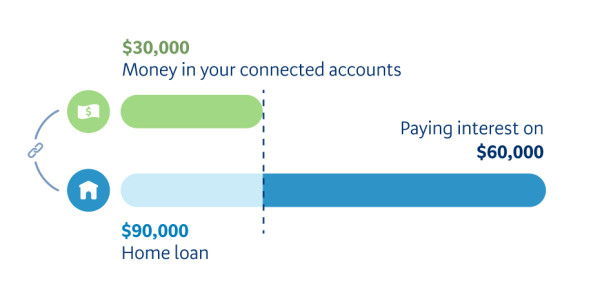
An offset home loan is designed to help you reduce the amount of interest you pay. You ‘connect’ accounts to it, and the balance of those connected accounts is subtracted from your offset home loan balance. You then only pay interest on the difference. Connected money doesn’t get locked against your home loan, so those funds are safe and can still be used if you need them.
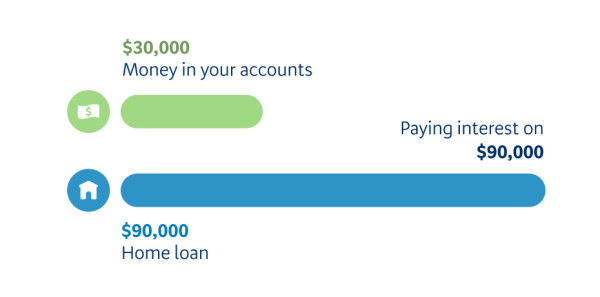
Let’s say you had an offset home loan of $90,000. And you then connect accounts to it that have a combined balance of $30,000. That money is subtracted from the offset home loan balance so you’d only pay interest on $60,000.
|
|
What’s the advantage of an offset home loan?
With an offset home loan you’re able to reduce the amount of interest you pay as part of each repayment. Your repayment amount will stay the same but when you’re offsetting, more of each payment goes towards the loan principal (the loan balance). More towards the principal and less towards interest means you’ll also be paying your loan off faster.
By reducing your balance faster, you could also reduce the amount of interest you need to repay over the lifetime of the loan.
Offset home loans have variable/floating rates
Floating home loans often have higher interest rates than fixed ones. This is due to the flexibility they offer, such as no additional charges if you pay the loan back sooner than expected. Unlike a fixed term home loan, floating rates can shift up and down with changes in the economic climate and affect your regular repayments.
However, if you’re able to fully offset the balance of your offset home loan, these fluctuations won’t affect you, as you won’t be paying interest on that portion. Fully offsetting your entire home loan would be pretty hard to achieve but being able to fully offset a portion of your loan makes avoiding interest more achievable.
Here’s an example to help explain – Imagine you have a $400,000 home loan and you decide to put the whole thing on a fixed rate term.
| $400,000 fixed rate home loan | |
| Interest rate p.a.* | 4.50% |
| Amount offset | N/A |
| Interest charged p.a. | $18,000 |
Now let’s compare the example above to including an offset home loan facility as part of your loan structure. Let’s say you split the home loan into one $350,000 fixed rate loan, and a $50,000 offset loan. If you were able to connect accounts with a combined balance of $50,000 to your offset loan, you would pay no interest on that portion/facility.
| $350,000 fixed rate home loan | $50,000 offset home loan | |
| Interest rate p.a.* | 4.50% | 6.5% |
| Amount offset | N/A | $50,000 |
| Interest charged p.a. | $15,750 | 0 |
These are simplifications and don’t account for things like shifts in repayments and your loan balance reducing over the course of a year, but it shows the potential benefit of having an offset home loan as part of your loan structure.
*Figures are for example only and should not be used as reference for current market rates.
What to know about eligible offset accounts
The main thing to keep in mind when it comes to offset home loans is an account connected to your offset home loan likely won’t earn credit interest while connected.
It’s important to remember though, that interest rates on a home loan are likely higher than that on a savings account. By paying your home loan off sooner, you could save money in the long term.
Family can also help offset your home loan
Depending on the bank, you may be able to connect selected accounts of your children or parents to help further offset your home loan.
While these accounts are connected to your home loan and help offset interest, the funds don’t get locked away and are still able to be accessed by the account owner.
There’s one important thing to consider though - connected accounts likely won’t earn credit interest. So, if someone – like a parent – uses interest from their savings to meet their everyday costs, it’s important they’re aware of this.
One way around this is to put an amount the account holder is comfortable with in a separate account and connect that to the offset home loan. This way, they can support someone’s offset goals while still earning the interest they use for everyday expenses.
Is an offset loan right for you?
There’s a lot to consider when it comes to offset home loans. Used correctly and carefully, though, they can be a great tool to reduce the amount of interest you pay and help you be mortgage free faster.
The best way to learn whether an offset home loan is right for you is to talk to a banker or financial advisor. They will help talk you through your options to see what fits your financial needs and lifestyle.
Related articles
Saving a deposit for a house
If you’re saving for a deposit on a house, find out how much you might need and discover ways to help you reach your goal.
Six ways to pay off your home loan faster
Living a mortgage-free life can feel like a pipe dream, but applying these six strategies could help make it a reality – and much sooner than you think.
Five things to consider each year to manage your mortgage
Reviewing your home loan regularly can help you find ways to pay it off faster. Get started with these useful tips.
Related products
Home loan types
Home Loan Partners
Related tools
TotalMoney offsetting calculator

Home loan repayment calculator
BNZ home loans
Find out more
BNZ home loans are subject to lending criteria, terms and conditions, and fees.
This article is solely for information purposes. It’s not financial or other professional advice. For help, please contact BNZ or your professional adviser.
No party, including BNZ, is liable for direct or indirect loss or damage resulting from the content of this article. Any opinions in this article are not necessarily shared by BNZ or anyone else.