- House prices flat for three years, but still 15% below 2021 peak, or 28% below in real terms
- A boost for affordability
- A global comparison of typical house price valuation metrics suggests that, despite some retrenchment in recent years, NZ is still middling-to-elevated when viewed over a longer period
- That doesn’t imply house prices need to fall further or can’t lift from here. There’s still a cycle
- But it does support our sense there’s downside risk on our house price inflation forecasts for this (calendar) year (0%) and next (4.5%)
There’s been a bit of attention recently, including in the global media, on the length and breadth of NZ’s house price downturn.
So, we thought we’d add some context. How long, how deep, how widespread, and how house prices now stack up relative to inflation, rents, incomes, and the rest of the world.
First, some housekeeping. There are several house price measures reported in NZ, which can cause confusion. We use the REINZ House Price Index (HPI). It’s timely and adjusts for compositional changes in house sales. Where a dollar value is required, we sub-in the REINZ median house price measure.
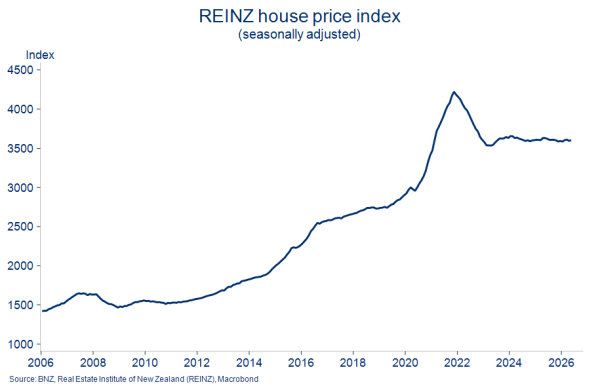
The chart plots the recent history of the HPI. After soaring 43% in the 18 months from May 2020 to November 2021, prices fell 16% down the other side. That period of falling house prices ended just over three years ago in the autumn of 2023. Prices have gone broadly sideways since.
Up, down, then flat
Lining up the post-2021 adjustment with the four other periods of house price decline we’ve seen since 1992 reveals it as the largest. The necessary context is that the 2021-2023 declines were immediately preceded by the largest house price boom since the 1970s. Boom, bust.
Deep dive
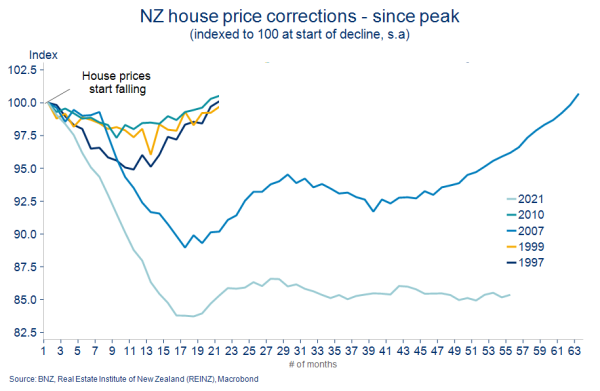
In the wake of the 2007 Global Financial Crisis correction, it took house prices 63 months to reclaim their previous peak. We’re 55 months into the current cycle, still 15% shy of the 2021 peak, with prices showing few signs of lift.
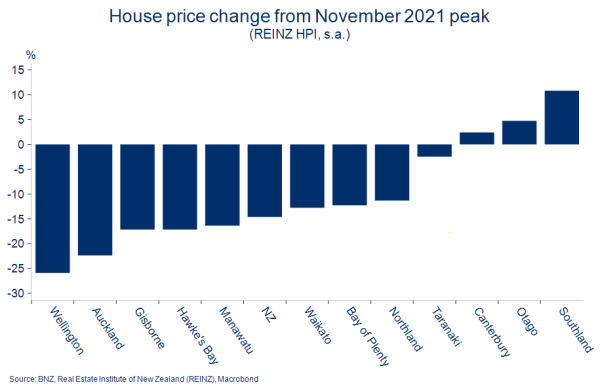
It’s important to recognise that this conclusion does not hold everywhere! Average house prices in Canterbury, Otago, and Southland have clawed back all of their modest losses recorded through 2022/23 and have thus made new highs. Prices in all other regions remain below the 2021 peaks, particularly Auckland (-22%) and Wellington (-26%).
Lower South Island bucks the trend
House price pain = affordability gain
The flipside of flat or falling house prices has been a material improvement in housing affordability.
There are many ways this concept can be measured. Our proxy combines the cost of an average (20%) house deposit with the first year of debt servicing payments and expresses those outgoings as a multiple of the average household income. The resulting index clearly won’t reflect all situations but provides a reasonable indication of affordability trends.
Improved affordability
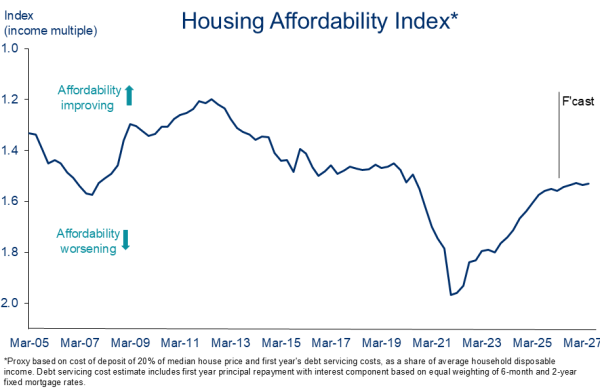
From a starting position of severe unaffordability in 2021, the average size of a deposit has reduced as house prices have come down, incomes have increased, and mortgage rates have been on an up-then-down round trip.
According to our index, the net of these factors has returned housing affordability to levels that last prevailed in mid-2020. That doesn’t necessarily imply houses are suddenly affordable outright, just that the overall situation has improved in recent years. Moreover, our forecasts for house prices, income growth, and mortgage rates combine to hint at further small improvements in the affordability index ahead.
A larger ‘real’ decline
When comparing house prices over long periods and across countries, it’s more useful to look at inflation-adjusted or real house prices. A house has not gained in ‘value’ if its price rises 5% in a year in which inflation is 7%.
Real NZ house prices have fallen back to where they were in mid-2019, 28% below the 2021 peak. Auckland and Wellington have experienced the largest real declines, at 35% and 40% below their respective peaks. No region – not even Southland – has seen real house prices eclipse 2021 levels.
Global comparisons
So, does the recent sluggish period for the housing market mean prices are now getting “low”?
It’s always a tricky one. No one measure (or economist) will give you a straight answer. But checking in on a few simple valuation metrics, pulling in some global comparisons, can at least provide a general steer.
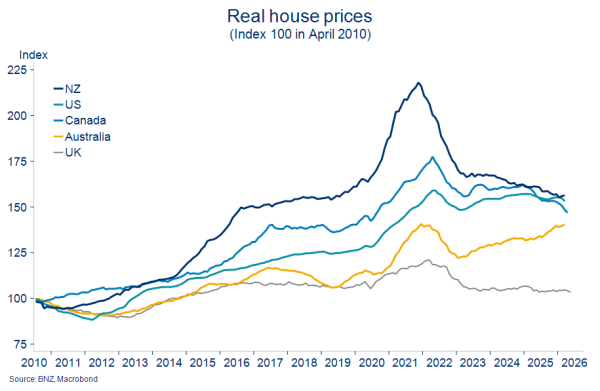
House price cycles in the US, UK, Australia, Canada and NZ tend to exhibit a reasonable degree of synchronicity. It’s nonetheless clear enough that the housing markets of the UK, US, and particularly Australia have outperformed NZ over the past five years.
Viewed in isolation, that might steer some towards the conclusion that some NZ catch-up is due. However, the degree of real NZ house price outperformance in the years prior, including and especially the COVID period, still puts NZ at the upper end of real house prices gains since 2010.
In the chart, we’ve rebased price indices to 2010. The relative rankings are naturally sensitive to the selection of this date. But we note the above conclusion broadly holds when flexing this assumption.
NZ real house prices elevated
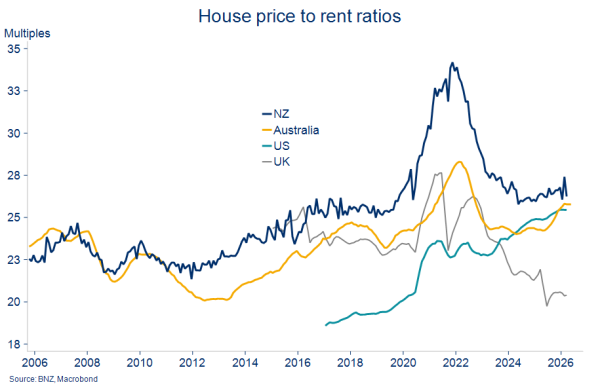
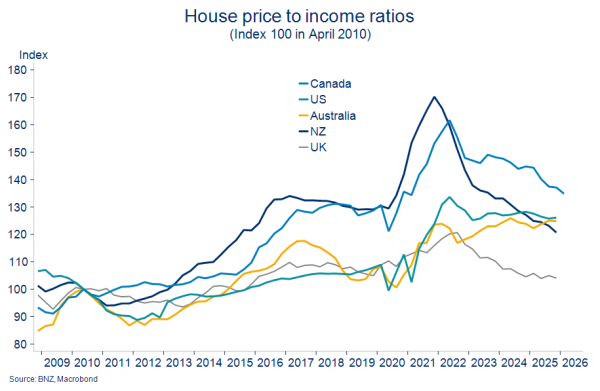
We can also check in on house price-to-income and house price-to-rent ratios. They’re commonly used metrics that assess the level of house prices relative to some sense of fundamentals. We’re quick to point out that house prices, like any asset price, can and often do diverge from fundamentals for long periods of time!
In comparing these measures with global peers, we need to add the caveats that getting like-for-like data can be difficult, and some housing markets may oscillate around structurally different long-run trends in these ratios.
With these duly noted, NZ lines up as having a relatively high house price-to-rent ratio relative to the US, UK, and Australia. That’s despite a sharp fall in recent years.
In contrast, comparing house prices to incomes across peer countries since 2010 shows NZ as more mid-pack. Again, the selection of the base year is important here (we’ve gone with 2010 again). What’s clear is that NZ’s house price-to-income index (courtesy of the OECD) has seen a larger retrenchment from 2021 extremes than the peer countries plotted, returning it to levels last seen in 2015.
NZ house price-to-rent ratio elevated
More mid-pack
What do we take from all this?
Drawing firm conclusions from any sort of global house price comparison or valuation computation is fraught with difficulty. But the ones we’ve looked at give the sense that, despite some retrenchment in recent years, NZ is still middling-to-elevated looking back over a longer time period.
Notably, the Reserve Bank’s modelling also puts current house prices above its indicator range of ‘sustainable’ prices, albeit much less so than previously.
None of this implies house prices need to fall further or can’t lift from here. House prices are cyclical in nature and the 2020/21 boom is evidence enough that upswings can take hold despite a stretched starting position if macro settings are supportive (interest rates, government policy, the labour market, and supply dynamics).
Equally though, the analysis here provides no impediment to the recent period of flattish house prices continuing. It supports our sense there’s downside risk on our house price inflation forecasts for this (calendar) year (0%) and next (+4.5%).
To subscribe to Mike’s updates click here.
- Economy & Markets