Listed in: Customer stories
Cannulight: Improving successful vein access in medicine
When Cannulight’s founder was studying dentistry, he noticed a small but important problem – he decided to make it his mission to fix it with a simple-yet-elegant solution.
0 minute read
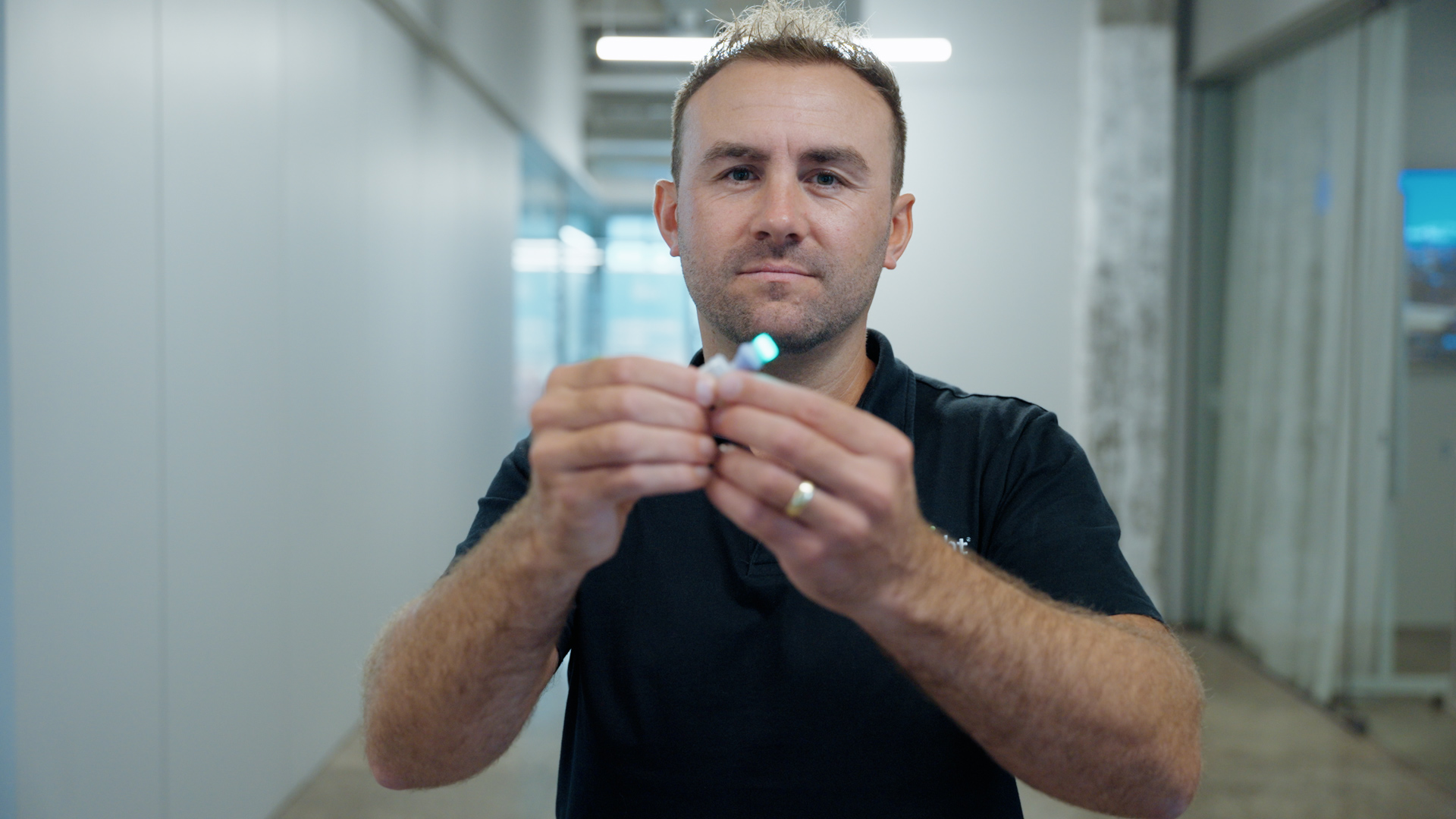
When something goes right in a clinical setting, it’s just another day. But when it doesn’t, the consequences can be significant. For dentist and founder Dr. James Stone, that reality became the spark for Cannulight – a simple but powerful device designed to improve the success of intravenous (IV) access.
Please note, this video contains footage of surgical needles. Those sensitive to the use of needles are advised to proceed with caution.
“Cannulight is an accessory device that fits on existing IV needles, and it's essentially the a little pressure sensor that fits on the back of the needle, and then when the needle hits the vein, it lights up green,” James explains. This device gives clinicians immediate confirmation they’ve successfully found the vein.
It is a straightforward idea, but one that solves a widespread problem.
First-hand experience of the problem
The idea for Cannulight began in 2018. At the time, James was studying dentistry, having always imagined a future in some form of surgery. It was during his training that he encountered the challenges of IV-access failures.
In hospital environments, missing a vein does more than slow things down. Failed IV access can create complications for patients, increase discomfort, and add stress in already demanding clinical settings. On average, first-time IV insertion success rates sit at around 65 percent, a figure that drops in stressful or low-visibility conditions.
James began looking at existing tools designed to help clinicians locate veins. While there were options available, none suited his specific environment or way of working in a dental clinic. Many were expensive, complicated, or required practitioners to alter their existing technique for it to work.
There was a need for something simple, low-cost, easy to dispose of, and able to slot seamlessly into established clinical practice.
The path from prototype to product
What started as a passion project quickly became more serious. Early prototypes were functional but rudimentary, enough to prove the concept, but far from ready for real-world use.
The challenge lay in bridging the gap between an early prototype and a product that could be manufactured at scale and trusted in critical environments. Overcoming this would require funding.
Private capital played an essential role in taking Cannulight from a concept to a market-ready medical device. It enabled further design refinement, testing, and the development of a manufacturing line in New Zealand.
For ambitious businesses, funding is rarely just about money. It is also about access to experience, networks, and governance. This access helps founders make better decisions as their business grows.
Support through BNZ’s Private Capital Forum
BNZ had been in conversation with James for some time before inviting him to take part in the BNZ Private Capital Forum.
Cannulight stood out. The solution was grounded in lived experience, addressing a problem James had personally encountered. At the same time, the device’s application was global, with relevance well beyond dental clinics and hospital settings.
Through the Private Capital Forum application process – and the mentoring support that followed – James was able to refine his pitch, sharpen his strategy and present Cannulight to a carefully curated group of qualified investors.
The outcome was significant. Cannulight raised funding through our Private Capital Forum, and the skills and confidence developed through this helped unlock further investment opportunities elsewhere.
Building and proving the technology
With funding in place, Cannulight moved quickly. The product design was finalised, and a manufacturing line was established locally. The technology itself is deceptively simple.
When the needle enters a vein, blood displaces the air within the needle, causing a pressure increase. Cannulight’s sensor detects that change and switches on. If the needle passes through the vein or moves out of position, the pressure drops and the light turns off. Clinicians receive real-time feedback throughout the process.
Independent testing has reinforced its impact.
Additionally, Cannulight has been used by combat medics in Ukraine, delivering positive feedback in some of the most challenging conditions imaginable.
The role of the right investors
For James, the most valuable investors bring more than capital. They bring perspective, mentorship, and a long-term commitment to him and the business.
Linda reinforces this idea, saying “It's a well-known business principle that well-funded businesses grow better. This is not because money solves everything, but it gives founders the freedom to focus on what they do best.”
In Cannulight’s case, that meant concentrating on product development, regulatory approvals and scaling for international markets, rather than managing funding and cash flow pressures.
That support has already paid dividends. Cannulight has lodged its Food and Drug Administration (FDA) applications in the USA, a major milestone that will open the door to the two largest medical device markets in the world.
Looking ahead
The journey so far has been fast-paced and rewarding, but it is only the beginning. For Cannulight, the combination of a simple, effective solution and strong investor backing has created momentum that continues to build.
This also reflects a broader commitment to backing ambitious New Zealand businesses who have the potential to make a meaningful difference, both at home and globally.
With the right idea, the right support, and the right partners, small innovations can have an outsized impact.
Related articles
SYOS Aerospace: How a Tauranga robotics startup has taken flight globally
Developing some of the world’s most technologically sophisticated uncrewed vehicles for air, land, and sea, SYOS Aerospace is aiming high and scaling fast.
Pitching to new investors
Pitching to raise funding can be a nerve-racking experience. Here are some top tips to really impress the panel.
Adjusting the building blocks of your business to help future growth
Help set your business up for future growth by making sure the building blocks of your business like, existing customers, cash flow, finding new customers, and automating sales processes, are locked in.
Finance options for business
Find out more
This article is solely for information purposes. It is not financial or other professional advice. Any views expressed in this article are the personal views of Linda Sturgess and Dr James Stone and do not necessarily represent the views of BNZ. For help please contact BNZ or your professional adviser. Neither BNZ nor any person involved in this article accepts any liability for any loss or damage whatsoever which may directly or indirectly result from any opinion, information or representation or omission, whether negligent or otherwise contained in this article.
Referrals to BNZ Private Capital are only available for wholesale investors as defined in the Financial Markets Conduct Act 2013 and are not available to retail investors.
BNZ only facilitates introductions between qualifying businesses and potential investors. BNZ does not advise on or recommend investment opportunities as suitable for businesses or their potential investors.